If you’ve ever spent time troubleshooting industrial machinery, from conveyor systems to packaging lines, you’ve likely encountered worm gear drives—and you’ve probably wondered how they hold their load when power cuts out, without needing constant braking. As a gear supplier who’s worked directly with maintenance teams and design engineers for over a decade, I’ve seen firsthand how the self-locking property of worm gears isn’t just a fancy engineering term—it’s a game-changer for applications where safety, reliability, and load holding are non-negotiable. Let’s break this down in plain, practical terms, no stuffy textbook jargon, because that’s what our customers actually care about. Gear
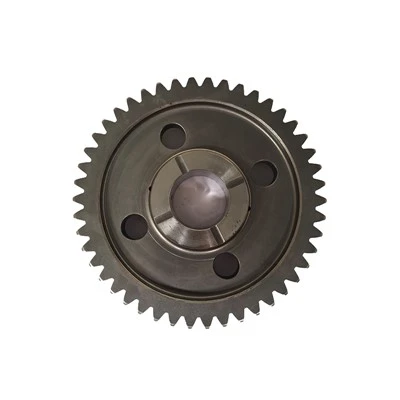
First, let’s start with the basics, but keep it focused. A standard worm gear set is made of two parts: a threaded screw (the worm, which is like a long bolt with one or more continuous threads) and a toothed wheel (the worm gear, or wheel) that meshes with it. When you turn the worm, the threads push against the gear’s teeth, making the gear rotate too. This setup gives huge speed reduction—think 50:1 or even 100:1 in a single stage—so it’s great for applications that need high torque without a big, bulky gearbox. But here’s the key: most people assume the drive works both ways, like a regular pair of spur gears, where you can turn either component to move the other. That’s not true for self-locking worm gears.
So what actually makes a worm gear self-locking? It all comes down to a simple trigonometric property of the worm’s threads, called the lead angle. The lead angle is the angle between the worm’s thread and the plane perpendicular to its axis of rotation. If you were to unwrap the worm’s threaded surface, it would look like a flat ramp, and the lead angle is the slope of that ramp. Here’s the rule of thumb engineers live by: a worm gear is self-locking if the lead angle is smaller than the gear’s friction angle. The friction angle is a value calculated from the coefficient of friction between the worm and gear materials (usually steel for the worm and bronze for the gear, two common pairs we supply here at our shop). For most standard gear sets, the friction angle ranges from about 5 to 8 degrees. That means if your worm’s lead angle is less than that (say, 4 degrees or lower), the gear will lock the worm. You can’t turn the gear to spin the worm—no matter how much force you apply. That’s the self-locking property in action.
Let me use a real example I ran into just last year to make this concrete. A customer of ours made custom material handling carts for steel mills, and their original gear set wasn’t self-locking. The carts would roll backward when they stopped, even with a handbrake, because the load on the cart’s gear would push on the worm’s threads, making it spin in reverse. They had to add a big, heavy magnetic brake to hold it in place, which cost extra, took up space, and added maintenance. We swapped in a self-locking worm gear set with a 3.2-degree lead angle. Suddenly, the cart held its full 2-ton load without any extra brake—just the inherent property of the gear set. No moving parts to wear out, no power needed to keep it locked. It was a small change, but it cut their maintenance costs by 15% in the first year, and they haven’t had a single roll-away issue since. That’s the practical value of self-locking, not just theory.
But wait—self-locking isn’t always a good thing. That’s the thing many new engineers get wrong. If you need a drive that works both ways (say, a steering system, where turning the wheels can turn the steering shaft), a self-locking worm gear will fail here because you can’t transfer force from the gear to the worm. That’s why we always ask customers two key questions before recommending a worm gear set: Do you need to hold a load without power? And do you ever need to manually rotate the output shaft (the gear) to move the input (the worm)? If the answer to the first is yes and the second is no, self-locking is perfect. If not, we’ll suggest a non-self-locking set, even if it has a lower speed reduction, because forcing a self-locking drive where it doesn’t belong leads to premature failure.
Another common misconception: self-locking is permanent. It’s not. Wear and tear over time can lower the effective coefficient of friction between the worm and gear, which changes the friction angle. If your gear set gets dirty, or if lubrication breaks down, the metal-on-metal friction drops, and suddenly a lead angle that was once smaller than the friction angle might be bigger. That’s why regular maintenance—replacing lubricant, checking for wear on worm threads or gear teeth—is critical to keeping the self-locking property intact. We see this with older equipment that’s been neglected: the self-locking stops working, loads slip, and mechanics blame the gear set instead of the lack of upkeep. That’s a mistake we help our customers avoid by including clear maintenance guidelines with every set we ship.
Let’s also talk about why material choice matters for self-locking. As I mentioned, most worm gears use a steel worm and a bronze gear. Bronze is softer than steel, so it wears slightly during operation, which helps maintain consistent friction. If you use a steel worm and a steel gear set, the coefficient of friction is lower—so those sets are almost always non-self-locking, even with small lead angles. That’s why we don’t offer steel-on-steel worm gear sets for applications that need self-locking; they just don’t perform reliably. We also machine our worm threads to very tight tolerances, because even a 0.1-degree difference in lead angle can push a set from self-locking to non-self-locking (or vice versa). Precision isn’t a luxury here—it’s the difference between a gear that holds a 5-ton crane load and one that slips.
I’ve had so many conversations with design teams who think self-locking is just a side effect of worm gears, not something you engineer intentionally. But it’s a deliberate specification. When we quote a custom gear set, we calculate the lead angle based on the application’s load, speed, and whether self-locking is required. For example, a conveyor belt that holds heavy pallets needs a self-locking set so it doesn’t move when the motor is off. A drill press feed mechanism needs it too, so the drill doesn’t drop under its own weight when you stop feeding. On the flip side, a robotic arm joint might need a non-self-locking set so you can manually reposition the arm for programming, without disconnecting power.
Last month, we worked with a customer that makes agricultural harvesters. Their header adjustment mechanism was using a non-self-locking worm gear, and when the harvester hit a bump, the header would shift, throwing the cutting height off by an inch or more. They tried adding a locking pin, but the pin wore out quickly from the vibration. We swapped in a self-locking set with a 5-degree lead angle—we adjusted it just under the friction angle for their steel worm and tin-bronze gear, which gives them enough strength to handle the header load while staying locked. No more locking pins, no more adjustment errors, and the harvesters have been running without issue all harvest season. That’s the kind of real-world impact we care about, not just specs on a page.
Now, if you’re in the market for a worm gear set—whether standard or custom—here’s what to ask yourself (and our team) before you buy: First, do you need the output shaft to hold its position when power is disconnected? Second, do you ever need to rotate the output shaft to move the input? Third, what’s the load and operating environment (temperature, dust, moisture) that the gear set will face? Answer those, and our team of engineers can pick the right lead angle, material, and precision machining to get the self-locking property exactly where you need it.
We don’t just sell gears here—we solve problems. Every set we ship comes with a full breakdown of its lead angle, friction properties, and maintenance tips, so you don’t have to guess. If you’re dealing with machinery that slips loads, needs more reliable braking, or is having issues with improper rotation, reach out to our team to talk through your specific needs. We’ll help you figure out if a self-locking worm gear is the right solution, no pressure, no sales pitch—just practical advice based on years of working with customers across every industry that uses gear drives.
At the end of the day, the self-locking property of a worm gear is about safety and peace of mind. It’s the reason you don’t have to worry about a pallet stack falling off a conveyor when the power goes out, or a crane load shifting while it’s parked. It’s a simple, mechanical solution that’s been used in industrial machinery for decades, but it’s still one of the most underrated features of worm gear drives. Don’t let misconceptions about how it works lead you to use the wrong gear set for your application. When you’re ready to upgrade your drive system, our team is here to help.
Transmission Shaft References
- Townsend, D. P., Dudley, D. W., & Ahn, S. (2000). Dudley’s Gear Handbook. McGraw-Hill.
- Shigley, J. E., Mischke, C. R., & Budynas, R. G. (2004). Mechanical Engineering Design. McGraw-Hill.
- ANSI/AGMA 6034-A08, Standard for Worm Gears and Worm Gear Drives. American Gear Manufacturers Association.
Yancheng Botu Transmission Machinery Co., Ltd.
As one of the most professional gear manufacturers and suppliers in China, we have world-leading production equipment and strong manufacturing capabilities. Please rest assured to wholesale cheap gear for sale here from our factory. Contact us for more details.
Address: No. 33, Yongxing Road, Economic Development Zone, Jianhu County, Yancheng City, Jiangsu Province
E-mail: 15261979878@163.com
WebSite: https://www.ycbtcdjx.com/
